
European Bee-eater: how to recognise it
One of Europe’s most colourful birds. Learn the marks that make it easy to identify, then practise with real photographs in Lore.
Practise with real photosExplore European birds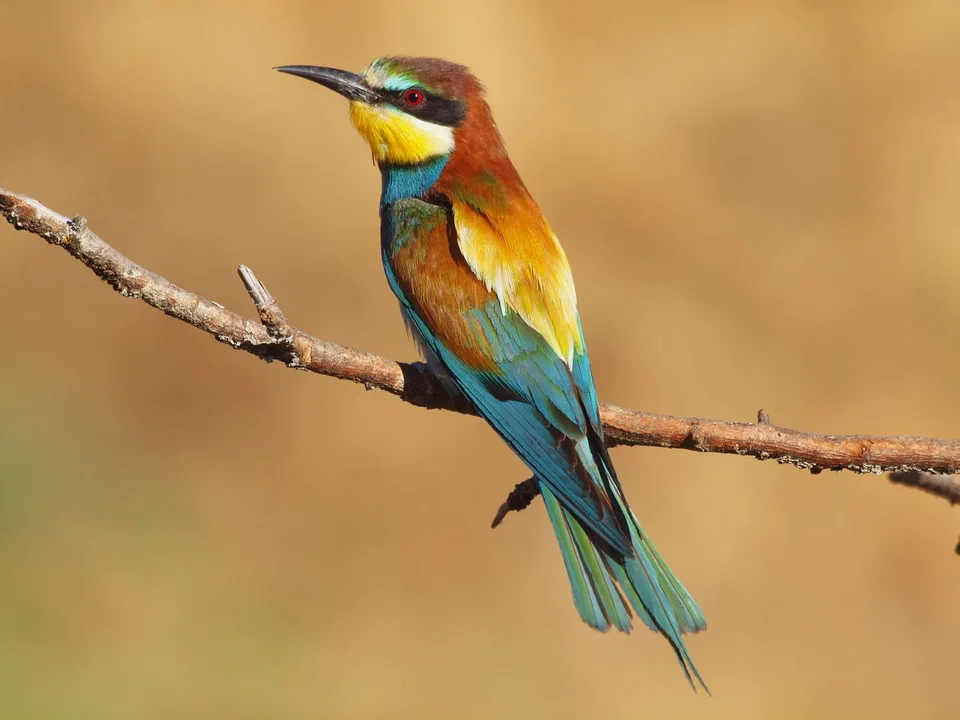
Photo © brugorraiztelefonicanet · CC BY-NC · iNaturalist · all photo credits
- Scientific name
- Merops apiaster
- Size
- About 27–29 cm, including the long central tail feathers
- Habitat
- Open country with trees, riverbanks and sandy banks
- Season
- Summer visitor to Europe; spends the winter in Africa
- Food
- Flying insects, especially bees, wasps and dragonflies
The key marks
Look for the colour pattern first: a chestnut crown and back, a yellow throat edged below by a narrow black band, a black stripe through the eye, turquoise-blue underparts and golden-yellow shoulders. The wings are long and pointed. Adults have two slightly elongated central tail feathers.
Behaviour and call
Bee-eaters often perch in the open on a bare branch or wire and sally out to catch insects in flight. In the air they glide on pointed wings. Listen for a soft, rolling prrip, often given by several birds at once.
Young birds
Juveniles look similar but duller, with less intense colours and shorter tail feathers. When the tail is not visible, use the colour pattern and the shape of the bill and wings.
Do not confuse with
No other European bird combines this pattern. If you see a blue-and-orange bird, compare the shape: the European Roller is stockier with a bigger head and brown back, and the Common Kingfisher is smaller, with a short tail and a long dagger-shaped bill.
Where and when
The European Bee-eater breeds mainly in southern and central Europe, nesting in colonies in sandy banks. It is a rare visitor in the Netherlands. Distribution changes from year to year, so check a recent local observation source before you go looking.