
Helmeted Guineafowl: how to recognise it
A bird seen on most continents. Learn the marks that make it easy to identify, then practise with real photographs in Lore.
Practise with real photosAll species guides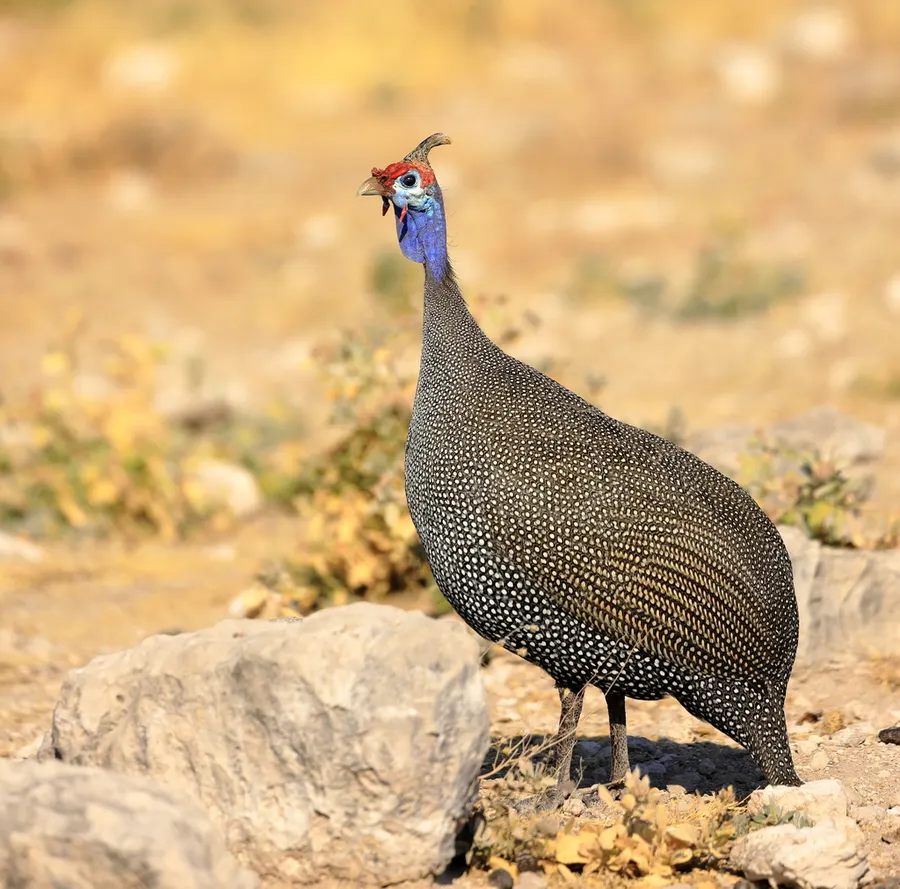
Photo © Darren Obbard · CC BY · iNaturalist · all photo credits
- Scientific name
- Numida meleagris
- Family
- Guineafowl
- Size
- About 58 cm
- Habitat
- Savanna, scrub, farmland and woodland edge
- Found in
- Europe, Africa, Asia, North America, South America and Oceania
The key marks
Round-bodied, dark grey fowl covered in small white spots, with a bare blue-and-red head topped by a bony casque. Vulturine Guineafowl has a slim, bare grey-blue head with no casque and a cape of long blue-and-white striped feathers.
Voice
Loud, harsh, cackling calls, often 'kek-kek-kek', from flocks.
Good to know
It lives in noisy flocks that scratch the ground for seeds and insects and roost in trees at night.
Do not confuse with
Compare it with the Vulturine Guineafowl. Look at the marks above one by one rather than the overall colour, and practise telling the two apart with real photos.
Where and when
You can expect to find it in savanna, scrub, farmland and woodland edge. It is especially common in South Africa, Kenya and Tanzania. Distribution changes with the seasons and from year to year, so check a recent local observation source before you go looking.