
Black-headed Gull: how to recognise it
A bird seen on most continents. Learn the marks that make it easy to identify, then practise with real photographs in Lore.
Practise with real photosAll species guides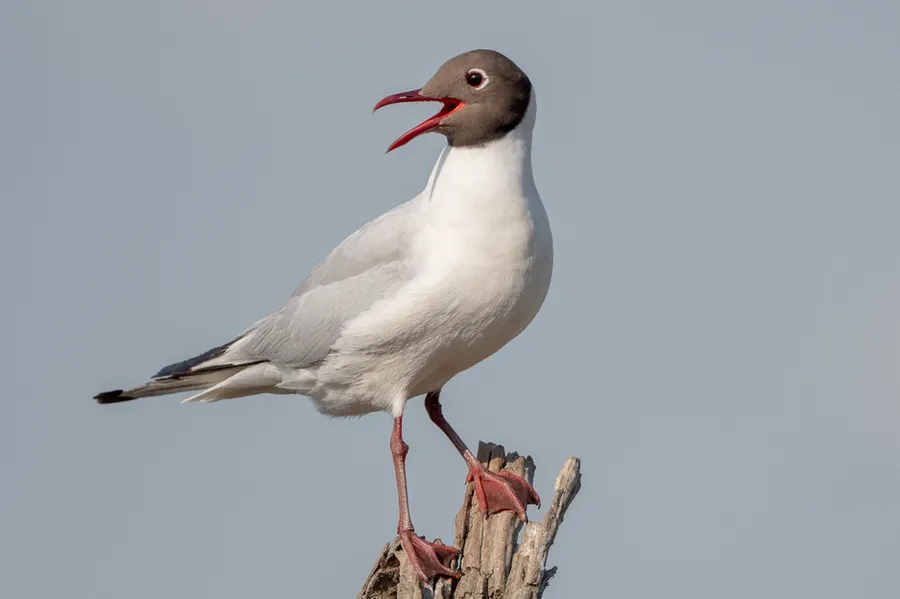
Photo © Dmitry Dubikovskiy · CC BY-NC · iNaturalist · all photo credits
- Scientific name
- Chroicocephalus ridibundus
- Family
- Gulls, Terns, and Skimmers
- Size
- About 37 cm
- Habitat
- Lakes, fields, coasts and city parks
- Found in
- Europe, Africa, Asia, North America, South America and Oceania
The key marks
Small gull with a red bill and legs, and a white leading edge to the outer wing in flight; in summer a chocolate-brown hood, in winter a dark spot behind the eye. Common Gull has a yellow-green bill and legs and black wing tips with white spots.
Voice
A harsh, screeching 'krreeah'.
Good to know
Its 'black' summer hood is actually dark brown and does not reach the back of the head.
Do not confuse with
Compare it with the Common Gull. Look at the marks above one by one rather than the overall colour, and practise telling the two apart with real photos.
Where and when
You can expect to find it in lakes, fields, coasts and city parks. It is especially common in Poland, the Netherlands, the United Kingdom and Sweden. Distribution changes with the seasons and from year to year, so check a recent local observation source before you go looking.